The 8 Superpowers Growth Hub · Edition 6
Strong relationships can protect today's revenue while quietly hiding tomorrow's problem.
Welcome to The 8 Superpowers Growth Hub.
Every Tuesday, I explore a CEO paradox — something about business growth that appears contradictory at first, but makes much more sense when you look beneath the surface.
These are patterns I've seen repeatedly during 35 years working inside more than 100 businesses.
The aim is simple: challenge one assumption leaders often take for granted, reveal what may really be happening underneath it, and leave you with a better question to take back to your leadership team.
This week's paradox
Yes. Your best customers can become a growth risk when loyalty creates customer concentration, dependence on individual relationships, excessive customisation or blind spots about where the wider market is moving.
Not because strong customers are bad.
They're enormously valuable.
But because the things that make those relationships feel safe can sometimes hide vulnerabilities elsewhere in the business.
A CEO tells me:
“Our customers are very loyal.”
That's good.
Then I ask:
And suddenly “customer loyalty” becomes a more complicated subject.
One of the most dangerous assumptions is that retention tells you whether a relationship is healthy.
Customers who stay can still be telling you something:
None of that shows up in a retention figure. It shows up in margin, in share of spend, in the number of exceptions you make, and in the conversations you're not having.
Staying is not the same as choosing you.
It is the same as not leaving yet. And the difference between the two is where most customer concentration risk actually sits.
Loyalty feels like strength.
Often it is also the mechanism that concentrates revenue. A customer who has been with you for a decade tends to grow with you, take more of your product set, ask for more of your time and become more of your revenue.
That feels like progress, because it usually is.
Until you ask a simple question:
What happens to this business if one of our top customers decides to consolidate, restructure, or buy somewhere else next year?
If that question is uncomfortable, the loyalty isn't the issue. The concentration is.
I have seen businesses where the top five customers account for more than half of revenue, and where every one of those relationships is described as a partnership.
That can be true. It can also be the most expensive version of peace a business can buy.
Because when a relationship becomes that important, pricing, process and even strategy start to bend around it. You customise more. You negotiate differently. You accept terms you wouldn't accept elsewhere. You stop asking whether the work is the right work.
The pattern to watch
The more a customer matters, the less you can afford to be the only person they belong to — and the less you can afford to have only them.
Concentration isn't only about revenue. There is a second form that boards rarely measure and leadership teams rarely name.
Relationship concentration.
It looks like this: the customer likes the CEO. Or the MD. Or one long-standing account director.
When that person is in the room, everything works. When they're not, the temperature changes.
Ask yourself who owns your most valuable relationships.
If the answer is one individual, then the risk is not in the customer base at all. It sits in your own organisational chart.
Strong customers create strong preferences. Preferences become requests. Requests become bespoke work.
Individually, each one is reasonable.
Collectively, they erode the repeatability of the business.
Consider what happens over two or three years:
None of this happens because anyone made a poor decision. It happens because the business kept saying yes to important customers, and nobody was watching what those yeses cost in aggregate.
A business that customises for everyone has no product. It has projects.
This is the distinction that matters most in this edition.
Customer proximity is how close you are to the people who already buy from you. Most strong businesses are excellent at it. They know their customers' names, their pressures, their politics and their calendar of decisions.
Market proximity is how close you are to the demand you don't yet serve. The customers who chose someone else. The segment emerging two years away. The problem being solved in another sector by a method you haven't seen.
You can be brilliant at the first and blind to the second.
That is precisely how a loyal customer base becomes a growth risk.
The market moves. Your customers, being loyal, keep buying what they already buy. The signals that would tell you to change reach your competitors first, because they are closer to the customers who didn't choose you.
Then one day a customer says:
“We're consolidating our supplier list this year.”
And what arrives as a commercial decision is actually a market signal that has been arriving quietly for some time.
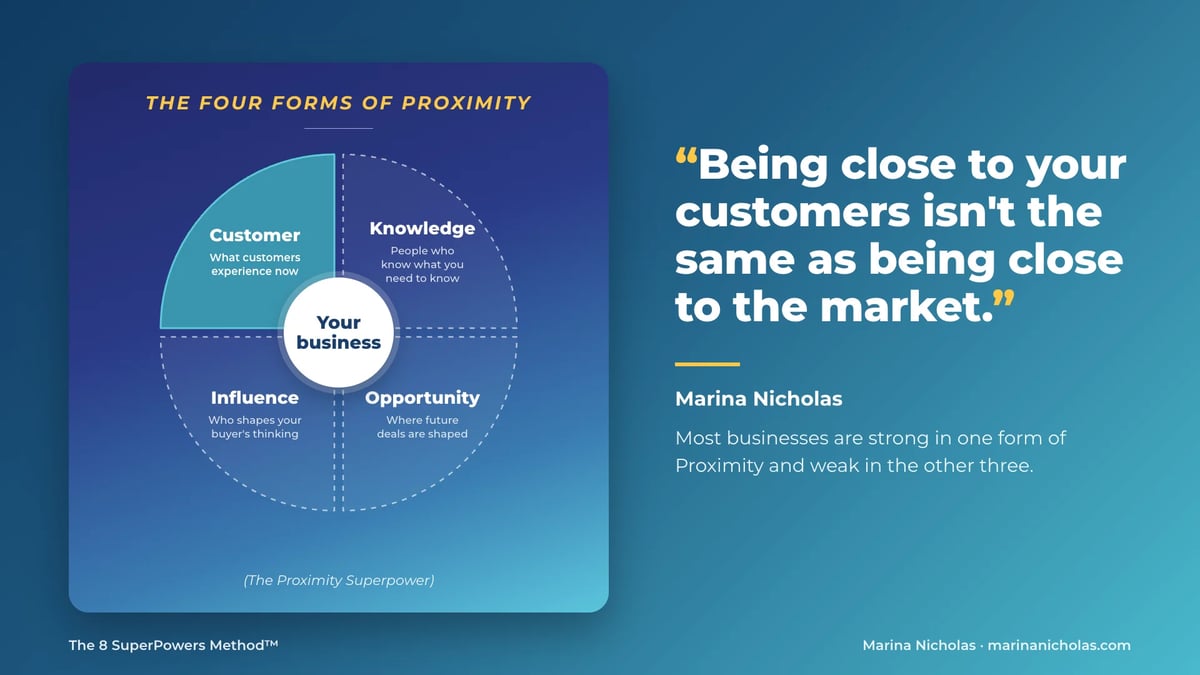
When I work with leadership teams, I don't treat proximity as a single capability. It has four forms, and most businesses are strong in one or two of them.
How close are you to the people who already buy from you?
Risk when overdone: you hear only what loyal customers tell you.
How close are you to the thinking, methods and evidence changing your field?
Risk when neglected: you keep improving yesterday's answer.
How close are you to the people whose view of your market shapes decisions you don't attend?
Risk when absent: your reputation is decided without you.
How close are you to demand you don't yet serve, and to the partners who could open it?
Risk when missed: you win the current market perfectly while the next one forms elsewhere.
The businesses that grow consistently are not the ones closest to their customers. They are the ones closest to all four.

Your customer base may be becoming a growth constraint if three or more of these are true:
Diagnostic checklist
The conclusion
If three or more ring true, the answer is not less loyalty. It is wider proximity.
Three practical shifts.
Name a second and third owner for every major account. Record what the customer actually values, not just who they like. Make the relationship survive a departure.
A relationship held by one person is an asset with a single point of failure.
Put revenue concentration on the leadership agenda next to growth. Track share of customer spend, not just customer satisfaction. Ask what percentage of revenue you would have to replace if your largest account left.
What isn't measured doesn't get managed, and concentration never announces itself.
Systematically talk to prospects you lost, customers who chose a competitor and buyers in the segment you want next. Treat that intelligence with the same rigour as a customer review.
Your existing customers will tell you how you are doing. They won't tell you what you're missing.
Proximity is the fourth of the 8 Superpowers of sustainable growth.
But it doesn't operate alone.
Weak Problem diagnosis means you may be very close to the wrong customers.
Persistence with a long-standing account can look like loyalty while becoming a Perseverance problem.
Without market proximity, weak Positioning is hard to see, because loyal customers keep buying anyway.
Where People capability sits determines whether relationships belong to the organisation or to one individual.
Partnerships are one of the fastest ways to build proximity to markets you don't yet reach.
Strong Process is what stops customisation for important customers quietly becoming the operating model.
Take your top five customers. For each, answer four questions honestly.
If most of your answers are about them, and almost none are about the market, you are practising customer proximity and calling it strategy.
Your best customers can protect today's revenue while quietly narrowing tomorrow's options.
Loyalty matters.
Concentration matters too.
The leadership task is not to choose between them. It is to keep earning the loyalty while staying close enough to everything else to know when to change.
The Boardroom Question
If our biggest customer left tomorrow, what would we learn about our business that we can't currently see?
The answer tells you more about the strength of your position than any satisfaction score will.
What have your best customers taught you about the market you don't already serve?
Not sure how close you really are? Take the free Growth Gap Report. It takes around five minutes and shows where growth may be getting stuck across the interconnected parts of your business.
Know a leader whose customer list has become very comfortable? Send this article to them.
— Marina Nicholas
The 8 Superpowers Growth Hub
If this sounds like your business, there are three ways to work on it with Marina:
New to the method? Read about The 8 Superpowers Method™.
The questions that come up most often when a loyal customer base starts to feel like a constraint.
Marina Nicholas is a multi-award winning professional who has spent 35 years working inside more than 100 businesses, from £1.8m engineering firms to £1 billion companies, such as Yorkshire Tea, the Co-op, Bank of America and Lloyds Bank, and mentored over 1000+ leaders.
She is the author of eight books on business growth, leadership, and entrepreneurship, and the creator of The 8 Superpowers Method™ for sustainable growth.
Read Marina's full story →