Can Being Good at Everything Make You Harder to Choose?
The 8 Superpowers Growth Hub · Edition 6
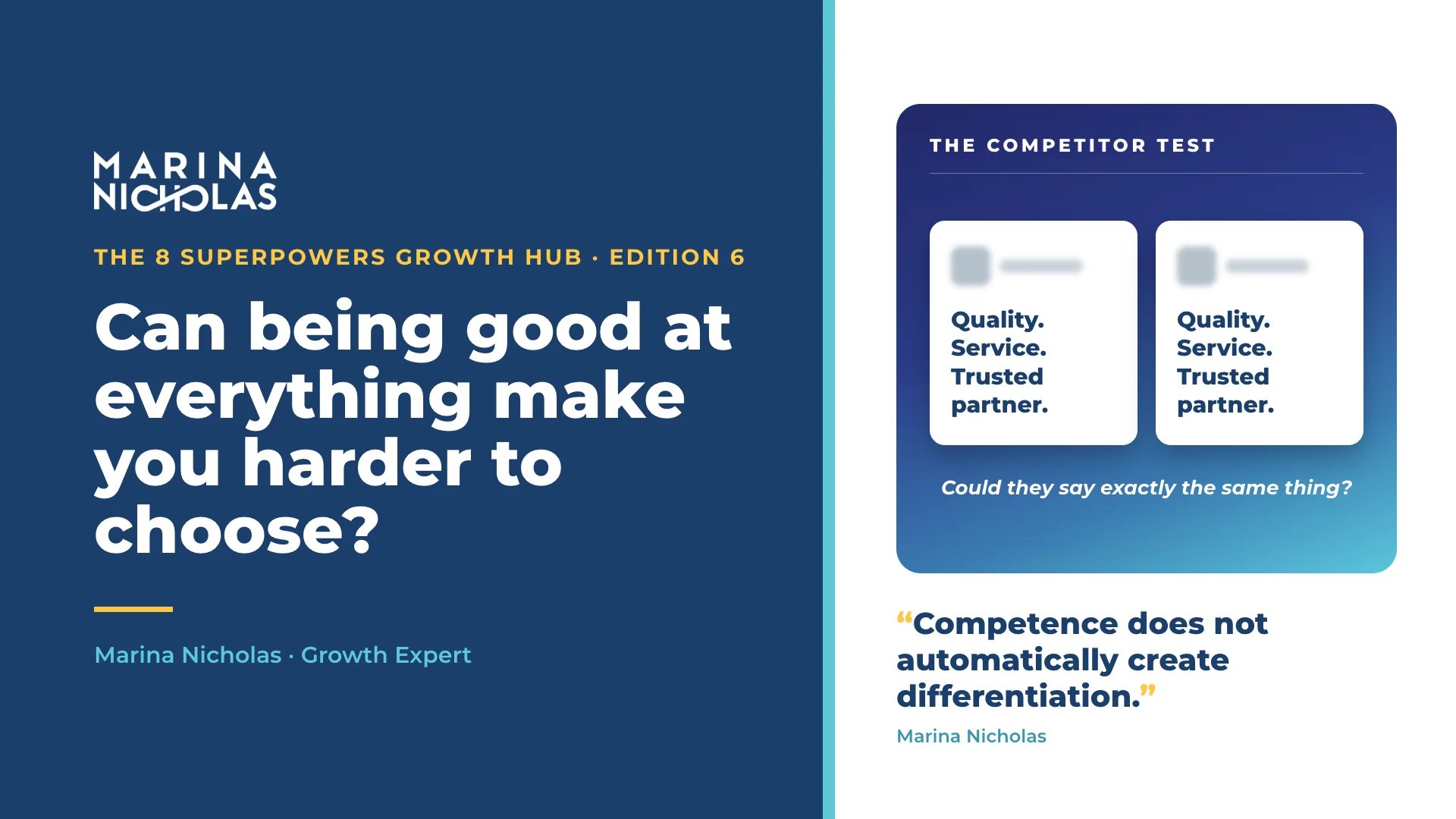
Competence does not automatically create differentiation.
Competence does not automatically create differentiation.
Welcome to The 8 Superpowers Growth Hub. Every Tuesday, one leadership paradox from 35 years inside more than 100 businesses.
This week on LinkedIn I've been looking at the third of the 8 Superpowers: Positioning. Today I want to get to the paradox underneath it.
This week's paradox
Yes. A business can become harder to choose when broad capability makes its differentiation unclear.
And I see this particularly in established businesses.
They're not bad companies. Quite the opposite. They have experienced people, good products, strong service, technical capability, long-standing relationships and years of evidence that they know what they're doing.
Then I ask:
“Why should a new customer choose you rather than your three strongest competitors?”
And the answers are often:
Our quality.
Our people.
Our service.
Our experience.
Our relationships.
All good things.
But there's a problem.
Their competitors say exactly the same thing.
The short answer
Yes. A business can become harder to choose when broad capability makes its differentiation unclear. Strong positioning requires customers to understand who the business is for, what problem it solves particularly well, what makes it meaningfully different and why they should choose it over the alternatives.
There is a natural assumption inside successful businesses:
If we're excellent, the market will recognise it.
Sometimes it does, particularly when growth comes through relationships and referrals.
Existing customers already know what you're like.
They don't need the business explained to them.
But growth eventually requires you to persuade people who don't already know you.
And that changes the challenge.
A new prospect asks:
The five questions every prospect is really asking
If the answer takes ten minutes to explain, your Positioning is doing too little work.
Use this distinction prominently:
Reputation is what people who know you think about you.
Positioning is the place you want to occupy in the mind of the market.
Then continue:
You can have an excellent reputation and weak Positioning.
I've seen businesses where customers absolutely love them.
Retention is strong.
Referrals are strong.
Leadership assumes that means the market proposition must also be strong.
Then you look at the website.
The same words as everyone else
Quality.
Service.
Innovation.
Trusted partner.
Tailored solutions.
Exactly what everyone else says.
The business may genuinely be exceptional.
But the language makes it invisible.
If your reputation is stronger than your positioning, ask:
What would a stranger understand about us in thirty seconds?
A quick test
Your positioning may be weaker than your reputation if three or more of these are true:
Diagnostic checklist
The conclusion
If three or more ring true, the next step probably isn't a new website. It's a clearer set of choices.
As businesses grow, they accumulate capability:
Eventually somebody asks:
“What do we do?”
And the honest answer becomes:
“A lot.”
That feels like strength internally.
Externally it can create confusion.
Because customers don't necessarily want to understand everything you're capable of doing.
They want to know:
Are you the right answer to my particular problem?
That's why positioning requires sacrifice.
You cannot occupy every position at once.
If you try to be:
Contradictions customers have to resolve
you create contradictions the customer has to resolve.
And customers don't generally reward businesses for making the buying decision harder.
You cannot occupy every position at once.
If you saw Thursday's post, you'll remember Walmart's early choices:
Those choices shaped:
The message and the operating model reinforced one another.
The question I ask leadership teams
Can I see our positioning in the way the company actually operates?
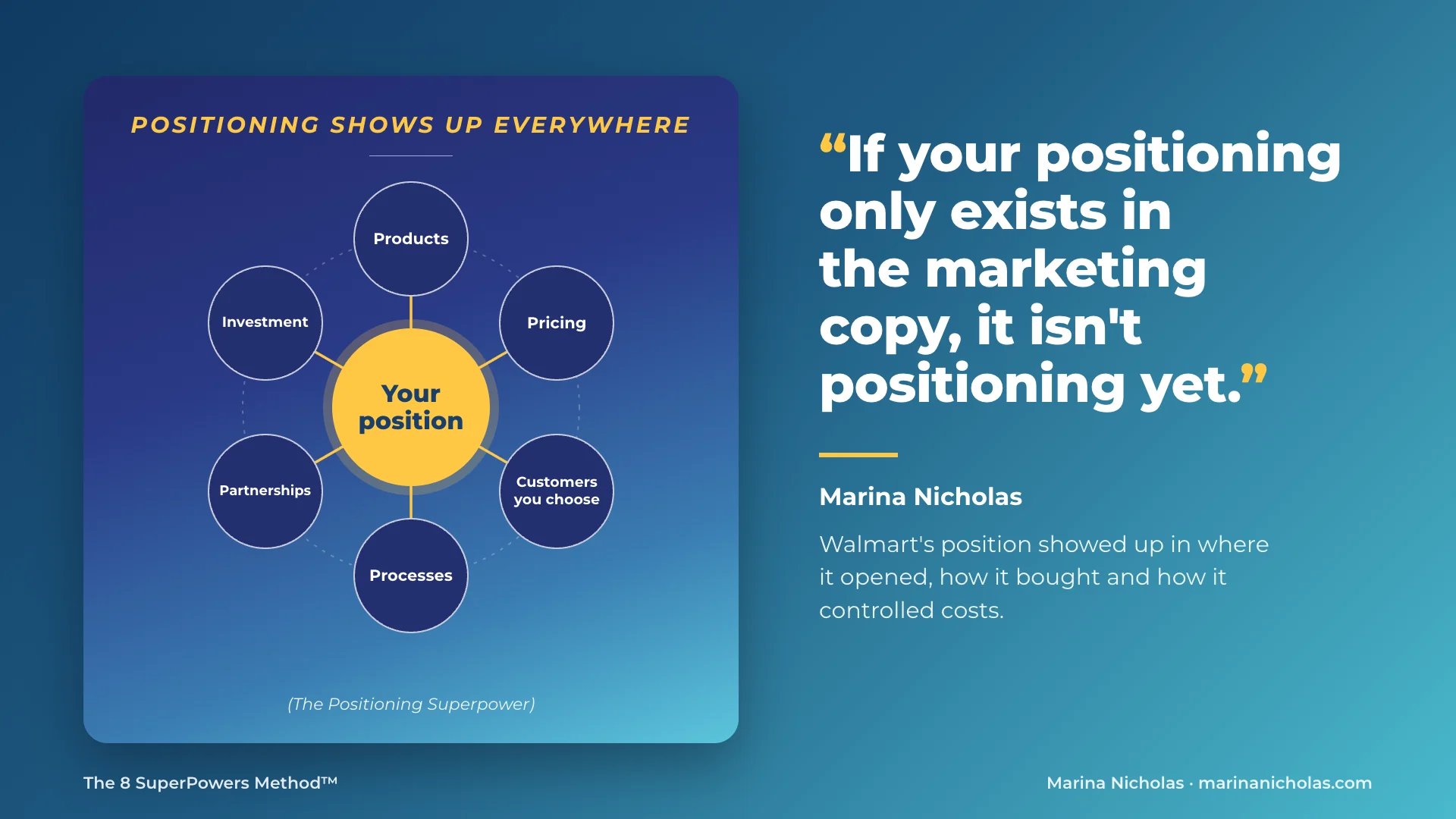
If your positioning only exists in the marketing copy, it isn't positioning yet.
When positioning is unclear, price becomes the only thing a new customer can compare.
And if price is the only comparable thing, you will lose.
Somebody will always be cheaper.
Not because they're better. Because they've made a different set of choices and are willing to be less for some customers in order to be the obvious choice for others.
That's positioning working as designed.
A premium price is only defensible when a customer can complete this sentence:
“We're paying more because we get ______.”
If your own team can't complete it consistently, in the same words, your positioning is doing too little work.
Including what not to be.
I've watched businesses try to fix weak positioning by adding.
New service. New market. New sector. New message.
But positioning rarely gets stronger by addition.
It gets stronger by subtraction.
And, by definition, who you are not for.
A position that includes everyone describes no one. The businesses with the clearest positioning can name the customer they serve better than anyone else — and the work they deliberately decline.
Not the list of things you're capable of.
Capability describes the business from the inside. Positioning describes the value from the outside. The question is not “what do we do?” but “what are we the obvious choice for?”
Different in a way the customer cares about.
Difference that isn't valued is decoration. The test is simple: would losing this make a customer choose someone else?
Positioning that doesn't change operations is a slogan.
If the position is genuinely new, something in the business has to move with it: pricing, hiring, product, process, investment or the customers you pursue.
If nothing inside the business has to change, you haven't chosen a position. You've written a sentence.
If you want a fast read on the strength of your positioning, run this.
The Competitor Test
Most leadership teams find that at least two answers are interchangeable.
That is the gap between competence and differentiation.
It rarely shows up in customer satisfaction. It shows up the moment a buyer who doesn't know you has to choose.
The single most useful question in this whole article:
If our three strongest competitors said the same words, what would a customer actually be choosing between?
Weak positioning is usually broad, warm and unarguable.
Strong positioning is narrower, sharper and deliberately arguable.
Positioning is the third of the 8 Superpowers of sustainable growth.
But it doesn't operate alone.
Poor Problem diagnosis means you position against the wrong problem — and sound like everyone solving a different one.
Without Perseverance, a position gets abandoned the first time the market doesn't immediately agree with it.
Weak Proximity means you position from inside the business rather than from what the market is actually saying.
The wrong People capability makes a position impossible to deliver — the promise outruns the team.
Weak Process breaks the promise quietly, which erodes trust faster than a weak message ever would.
Sometimes what looks like a marketing problem really is a positioning problem.
And sometimes what looks like a positioning problem is another Superpower telling you the business can't yet deliver what it claims.
You don't need a rebrand to start this work. You need an honest hour.
Competence gets you trusted. Positioning gets you chosen.
The Boardroom Question
If a new customer compared us with our three strongest competitors, what exactly would they be choosing us for?
If the answer takes ten minutes, or your leadership team answers it differently, you've found the work.
What's one thing your business could stop doing that would make your positioning clearer?
Not sure whether you're well positioned or just well liked? Take the free Growth Gap Report. It takes around five minutes and shows where growth may be getting stuck across the interconnected parts of your business.
Know a leader whose business is excellent but hard to describe? Send this article to them.
— Marina Nicholas
The 8 Superpowers Growth Hub
If this sounds like your business, there are three ways to work on it with Marina:
New to the method? Read about The 8 Superpowers Method™. Or explore Power of Positioning.
The questions that come up most often when a well-run business suspects it is hard to choose.

Marina Nicholas is a multi-award winning professional who has spent 35 years working inside more than 100 businesses, from £1.8m engineering firms to £1 billion companies, such as Yorkshire Tea, the Co-op, Bank of America and Lloyds Bank, and mentored over 1000+ leaders.
She is the author of eight books on business growth, leadership, and entrepreneurship, and the creator of The 8 Superpowers Method™ for sustainable growth.
Read Marina's full story →