Can a Business Grow and Become Less Valuable at the Same Time?
More revenue does not always mean a better business.
Key Takeaways
- Revenue and value are not the same thing. A business can grow turnover while margins fall, cash tightens and dependence on the CEO increases.
- Visible growth hides invisible risk. Revenue is easy to celebrate. Margin, cash conversion, customer concentration and decision dependency are not.
- Three shifts protect growth quality. From revenue to revenue quality, from capacity to scalability, and from founder dependence to organisational value.
Welcome to The 8 Superpowers Growth Hub.
Every Tuesday, I explore a CEO paradox — something about business growth that appears contradictory at first, but makes much more sense when you look beneath the surface.
These are patterns I've seen repeatedly during 35 years working inside more than 100 businesses.
The aim is simple: challenge one assumption leaders often take for granted, reveal what may really be happening underneath it, and leave you with a better question to take back to your leadership team.
This week's paradox:
Can a business grow and become less valuable at the same time?
Yes.
And it happens more often than most leadership teams realise.
We tend to use revenue as shorthand for growth.
£5m becomes £7m.
£10m becomes £15m.
£25m becomes £35m.
The number gets bigger, so we assume the business is becoming stronger.
But revenue only tells you how much you sell.
It does not tell you what kind of business you are creating in order to generate those sales.
A company can grow turnover while:
- margins fall;
- cash gets tighter;
- customer concentration increases;
- management complexity rises;
- delivery becomes less predictable;
- more people are needed for every additional pound of revenue;
- and the CEO becomes more essential.
So leadership teams need to distinguish between:
Revenue growth and value growth.
They are not the same thing.
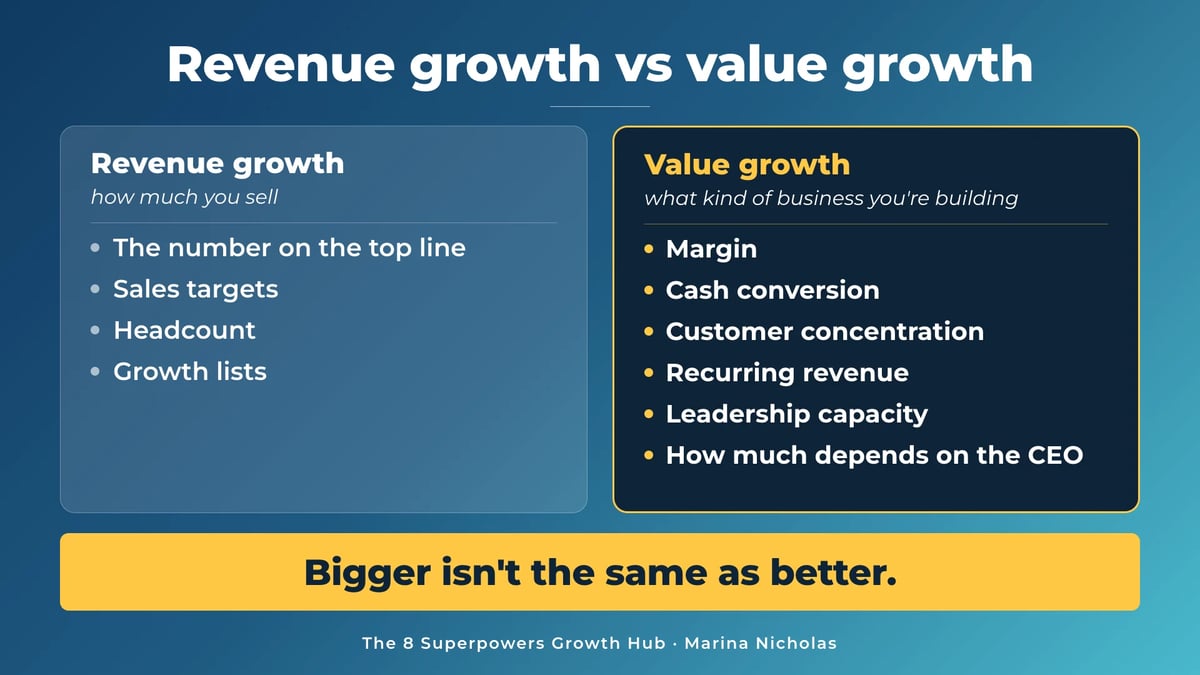
How can more sales make the business worse?
Imagine a company generating £10m in revenue.
It wins another £3m of business.
On paper, that's 30% growth.
But the new work is lower margin.
It requires more working capital.
It depends heavily on one customer.
The business has to recruit quickly to deliver it.
Managers spend more time firefighting.
Systems that worked at £10m begin to strain at £13m.
And the CEO becomes involved in more operational decisions because management capability hasn't grown at the same speed as revenue.
The company is bigger.
But is it better?
That's the question revenue alone cannot answer.
Why do leadership teams get caught by this?
Because revenue is visible.
It's simple.
It's easy to celebrate.
Sales targets rise.
Headcount increases.
The business appears on growth lists.
The leadership team can point to a bigger number and say: "We're growing."
But the things that determine the quality of that growth are often less visible:
- margin;
- cash conversion;
- customer concentration;
- recurring revenue;
- leadership capacity;
- operational repeatability;
- decision dependency;
- strategic fit.
Those measures can tell a very different story.
I've seen businesses where the sales team is hitting its target while profitability deteriorates.
Businesses winning work faster than Operations can deliver it.
Businesses hiring more people simply to compensate for poor processes.
And businesses where the founder has created a much larger organisation — but also one that is even more dependent on them.
That's growth.
But it isn't necessarily progress.
So what does good growth look like?
I would ask whether growth is making the business:
- More profitable.
- More repeatable.
- More resilient.
- Less dependent on individuals.
- More valuable to customers.
- Easier to scale.
- More strategically differentiated.
If revenue rises while most of those measures move in the opposite direction, I would question the quality of the growth.
Because the real objective shouldn't simply be: How do we make the company bigger?
It should be: How do we make the company better as it gets bigger?