If AI Gives Every Competitor the Same Strategy, What Sets Your Business Apart?
Leading in a world where intelligence is no longer scarce
Key Takeaways
- Strategy is no longer the advantage: AI gives every competitor the same analysis and the same answers.
- Execution is: what sets a business apart is how fast its leadership decides, how well its systems turn decisions into action, and how well its people work together.
- Three shifts: from knowing to deciding, from strategy to systems, and from individual brilliance to collective intelligence.
When every business can ask AI for a strategy, the strategy stops being the advantage. What sets a business apart now is how fast its leadership team decides, how well its systems turn those decisions into action, and how well its people work together. In 35 years inside more than 100 businesses, I've rarely seen growth stall for lack of ideas. It stalls because the ideas never become aligned, repeatable execution.
What has actually changed?
Intelligence used to be scarce. The leader with the best analysis, the sharpest read of the market or the cleverest plan had an edge. Today AI can produce a market analysis, a competitor review and a ten-point strategy in seconds, and your competitors have the same tools, the same data and the same answers.
So the question is no longer "Who is the smartest person in the room?" It's "Who can lead when everyone in the room has access to the same intelligence?"
Why doesn't a better strategy fix a stalled business?
Because in most stalled businesses the strategy isn't the problem. Many leadership teams still run on an older model: hiring for intelligence over execution, rewarding ideas over outcomes, and confusing complexity with sophistication.
Intelligence alone doesn't scale. What scales is clear decision-making, strong systems and an aligned team. Without them, even the cleverest organisations stall, and I see it at every stage of the business life cycle.
What do leaders need to do differently?
Three shifts.
1. From knowing to deciding. When everyone has the insight, indecision becomes the bottleneck. The leaders who move their businesses forward cut through the noise, prioritise with clarity and make decisions with incomplete data. The risk today isn't poor thinking. It's overthinking.
2. From strategy to systems. A strategy without a system to run it is a document. Growing businesses need scalable processes, feedback loops and an execution rhythm: clear objectives, 90-day sprints and a small set of numbers the leadership team reviews every week. That's what turns a one-off win into consistent results.
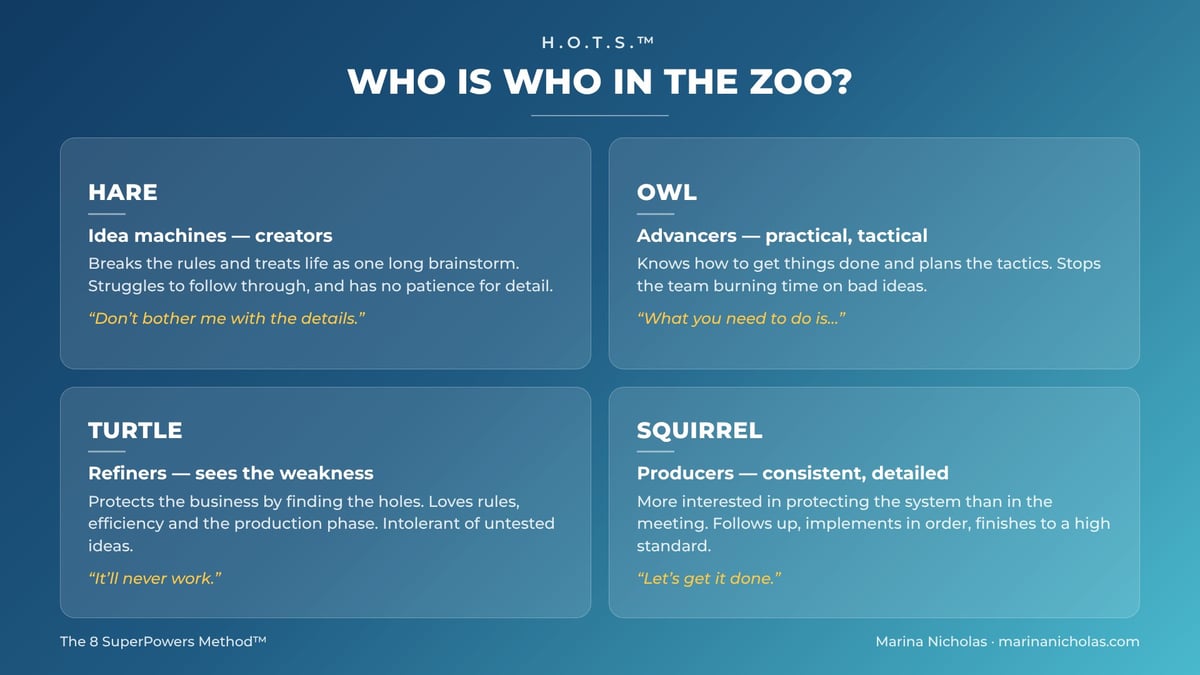
3. From individual brilliance to collective intelligence. The smartest leader in the room is no longer the advantage. A balanced, high-functioning team is. I use the H.O.T.S model to show leadership teams their own balance:
- Hares are the idea machines: they create, push new ideas and set the pace.
- Owls are the advancers: practical and tactical, they work out how things get done.
- Turtles are the refiners: they spot the weakness and protect the business.
- Squirrels are the producers: consistent and detailed, they finish to a high standard.
A team heavy with Hares moves fast and breaks things. A team heavy with Turtles moves too slowly and gets overtaken. Most leadership teams I meet are missing at least one of the four, and nobody has named it.
What does this look like in a real business?
Eco Providers, an £18m+ energy and environmental services business, came to me scaling fast but stuck firefighting. Decisions were reactive, the leadership team wasn't aligned, and nobody had time to think beyond the week. They didn't need a better strategy. They needed to decide faster and execute together.
Over 12 months we put in structured decision-making, a 12-month plan broken into 90-day sprints, and a leadership team that owned the priorities together. The result: 20% revenue growth, execution three times faster, and a business so well aligned across its people, processes and plan that it was later successfully sold.
As the MD, Tom Myers, put it: "Before working with Marina, our leadership team struggled with alignment and clarity as we scaled."
So what is a leader's job now?
In a world where strategy is expected, insight is available and knowledge is cheap, leadership is no longer about being right. It's about building an organisation that decides faster and executes better than everyone else. The leaders who thrive won't be the smartest. They'll be the ones who orchestrate execution, build aligned teams and make decisions when the stakes are highest.
Which of the eight is holding your execution back? Take the free Growth Gap Report. It takes 7 minutes and shows where growth is stuck in your business.
Know an MD or CEO this would help? Send it to them.
Where To Go From Here
If this sounds like your business, there are three ways to work on it with Marina:
- Free Growth Gap Report — 7 minutes to see where growth is stuck
- The Growth Intensive — 4 weeks with Marina on one or two contained problems
- The 8 Superpowers Accelerator — 12 weeks with Marina as your Strategic Growth COO
New to the method? Read about The 8 Superpowers Method™.