Can Resilience Become a Reason a Business Stops Growing?

By Marina Nicholas •
Perseverance

The 8 Superpowers Growth Hub · Edition 5

Can Resilience Become a Reason a Business Stops Growing?

Sometimes surviving the past makes it harder to change for the future.

Key Takeaways

  • Resilience and adaptability are not the same thing. A business can become extremely good at surviving inside a model that no longer fits.
  • Persistence without learning is repetition. Strategic perseverance means each setback generates new information, not another lap of the same lap.
  • The Crisis Habit is expensive. When heroics replace system design, resilience quietly becomes the operating model and the CEO becomes permanently indispensable.

Sometimes surviving the past makes it harder to change for the future.

Welcome to The 8 Superpowers Growth Hub.

Every Tuesday, one CEO paradox from 35 years inside more than 100 businesses.

This week on LinkedIn I've been looking at the second of the 8 Superpowers: Perseverance, and why knowing when to stop is a Superpower too.

Today I want to get to the paradox underneath it.

Can resilience become a reason a business stops growing?

Yes.

And it's particularly difficult to recognise, because resilience is something most successful organisations are rightly proud of.

We survived a recession.

We survived Covid.

We survived losing our biggest customer.

We survived losing a key leader.

Every time the organisation survives, it builds confidence.

“We've been through worse than this before.”

Usually that's a strength.

Until it becomes:

“Therefore the way we've always done things will get us through this too.”

That's where resilience can quietly turn into resistance.

Survival Creates Its Own Beliefs

Every business develops stories about itself.

We're entrepreneurial.
We move quickly.
Our customer relationships protect us.
Our people always find a way.
We don't give up.

Those beliefs are usually rooted in real experience.

The business survived because people worked extraordinary hours, the CEO stepped in, teams improvised, costs were cut and customers were protected.

That creates organisational muscle memory.

The next time pressure arrives, people repeat what worked before.

That's perfectly rational.

But what if the next problem is fundamentally different?

Ley Rubber: When Resilience Wasn't the Answer

I saw a version of this at Ley Rubber, a manufacturer with more than 40 people.

On the surface, the problems looked operational:

  • meetings dragging on
  • disjointed communication
  • resistance to change

Underneath, the workforce wasn't one team.

Long-standing staff and newer people, on different shifts, had different ideas of how things should be done.

So instead of another round of process fixes, we ran a two-day workshop with the entire workforce to agree shared culture and values.

More than 40 people took part.

The business came out with:

  • new shared values
  • 100% culture alignment reported
  • better collaboration
  • clearer direction

The pattern to watch

The behaviour that helped you survive the last crisis may not be the behaviour that helps you win the next growth stage.

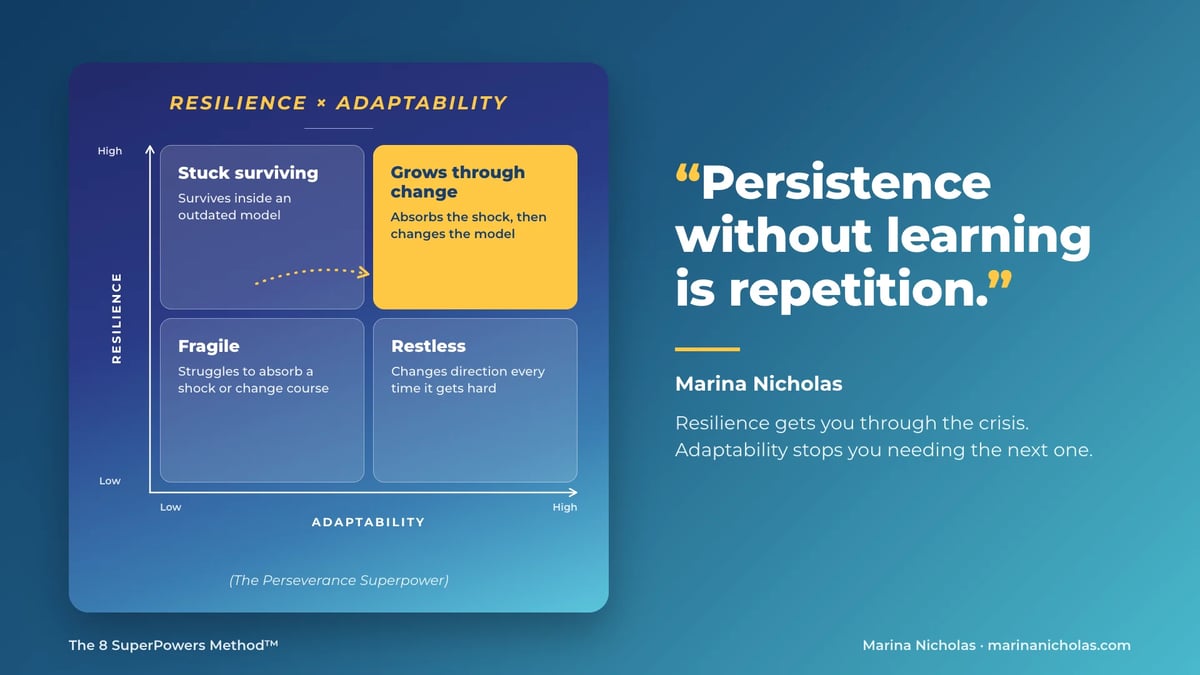
Resilience and Adaptability Are Not the Same Thing

This is the distinction I make.

Resilience says:
We can absorb a shock and keep moving.

Adaptability says:
We are willing to change how we move when the environment changes.

You need both.

A company with adaptability but no resilience changes direction every time something gets difficult.

A company with resilience but no adaptability becomes incredibly good at surviving inside an increasingly outdated model.

That can be just as dangerous.

Chart showing resilience and adaptability matrix with four quadrants: stuck surviving, frozen, bouncing, and crease through. Quote by Marina Nicholas about persistence.
Persistence without learning is repetition.

Perseverance Doesn't Mean Repeating Yourself

Some of you will have seen Thursday's post on James Dyson. Here's the part I want to take further.

5,127 prototypes, over five years.

The interesting part isn't simply that he kept going.

It's that he kept learning.

Prototype 3,000 wasn't identical to prototype 1.

Each failure generated information.

Something changed.

Another test happened.

The solution evolved.

That is strategic perseverance.

Persistence without learning is repetition.

And leadership teams need to know the difference.

I've seen businesses pursue the same initiative year after year because:

“We've already invested too much to stop.”

That's sunk cost wearing the clothes of perseverance.

I've seen leaders continue with products customers are buying less of because:

“They've always been our core business.”

That's history masquerading as strategy.

And I've seen organisations keep senior structures long after the business has outgrown them because:

“They got us here.”

All of those statements may be true.

They don't tell you what should happen next.

The Crisis Habit

There is another danger in highly resilient businesses.

They can become excellent at firefighting.

A problem appears.

Senior people jump in.

Everybody works harder.

Customers get protected.

The crisis passes.

The business congratulates itself, and rightly so.

Except:

The underlying operating system never changes.

So six months later:

Another crisis → another heroic response → another recovery.

Eventually resilience becomes part of the business model.

The organisation is incredibly capable of recovering from problems it should have designed out years ago.

That's expensive.

It exhausts good people.

And it can make the CEO feel permanently indispensable.

If your organisation regularly says, “Don't worry, we'll find a way,” ask another question:

“Why do we keep needing to?”

A Quick Test: Is Resilience Holding Back Your Growth?

Your resilience may be holding back growth if three or more of these are true:

Diagnostic checklist

  • The same kind of crisis has happened more than once in the last two years.
  • Senior people regularly step in to rescue delivery.
  • “We'll find a way” is said more often than “Why did this happen?”
  • At least one initiative has run for over a year and nobody can say what it has taught you.
  • This year's plan looks a lot like last year's.
  • Stopping something is rarely on the leadership agenda.

The conclusion

If three or more ring true, the next step may not be more perseverance. It may be deciding what to change — or what to stop.

Sometimes Perseverance Means Stopping

This is the part leaders find uncomfortable.

Starting something is optimistic.

Stopping something feels like admitting failure.

But strategic leadership requires both.

Last month, eBay announced a restructuring that will cut around 9% of its workforce and redirect resources towards its highest-priority strategic initiatives.

At the same time, the company said its latest quarterly performance was expected to come in above its previous forecast.

Whatever you think of the specific decision, the broader point matters.

Companies sometimes have to reallocate resources before they are in trouble.

Strategy can't simply be:

What are we adding?

It also has to answer:

What no longer gets the time, people and capital?

Because every initiative you continue consumes resources that can't be invested somewhere else.

Three Tests I Use

Before continuing with anything, ask these three questions.

1

The Learning Test

What do we know now that we didn't know six months ago?

If an initiative has struggled but you're learning something valuable each time, perseverance may be justified.

If nothing new is being learned and the results aren't changing, repeating the exercise deserves challenge.

2

The Evidence Test

What evidence would cause us to change our mind?

If the honest answer is “nothing”, you no longer have a strategy.

You have a belief.

Strong leaders can hold conviction while remaining willing to be proved wrong.

3

The Opportunity-Cost Test

If we stopped this tomorrow, what could we do with the resources instead?

This changes the conversation.

An initiative doesn't have to be terrible to be stopped. It simply has to be less valuable than the alternative.

Leadership is rarely choosing between good and bad. More often, it's choosing between good and better.

Where Perseverance Sits in the 8 Superpowers

Perseverance is the second of the 8 Superpowers of sustainable growth.

But it doesn't operate alone.

Problem

Poor Problem diagnosis can make you persevere with the wrong objective.

Positioning

Weak Positioning can make you work harder to sell something customers no longer value enough.

Proximity

Poor Proximity means you may miss the market signals telling you to adapt.

People

The wrong People structure can create dependence on heroic individuals.

Process

Weak Process can mean the organisation uses perseverance to compensate for systems that should have been fixed.

Sometimes what looks like a lack of perseverance really is one, and the answer is to keep going.

And sometimes what looks like admirable perseverance is another Superpower telling you it's time to change.

Look Back at Your Hardest Year

Think about the hardest period your organisation has survived.

What behaviour got you through it?

  • Longer hours?
  • The CEO stepping in?
  • Cutting costs?
  • Making every decision centrally?
  • Putting everything else on hold?

Now ask:

Is that behaviour still helping us grow, or have we simply become very good at repeating it?

Yesterday's survival mechanism can quietly become tomorrow's growth constraint.

Resilience matters.

Perseverance matters.

But sustainable growth needs the strength to keep going when the evidence supports you, and the courage to change when it doesn't.

The Boardroom Question

What are we continuing because it worked before, rather than because the evidence says it will work next?

The answer may reveal something you've been calling perseverance that is really attachment.

What's one thing your business still does because it got you through a hard time?

Not sure whether you're persevering — or just repeating? Take the free Growth Gap Report. It takes around five minutes and shows where growth may be getting stuck across the interconnected parts of your business.

Know a leader whose team has become very good at firefighting? Send this article to them.

— Marina Nicholas
The 8 Superpowers Growth Hub

Questions Leaders Ask About Resilience

The questions that come up most often when a resilient business suspects its resilience is holding it back.

About Marina Nicholas

Marina Nicholas - Business Strategist and Author

Marina Nicholas is a multi-award winning professional who has spent 35 years working inside more than 100 businesses, from £1.8m engineering firms to £1 billion companies, such as Yorkshire Tea, the Co-op, Bank of America and Lloyds Bank, and mentored over 1000+ leaders.

She is the author of eight books on business growth, leadership, and entrepreneurship, and the creator of The 8 Superpowers Method™ for sustainable growth.

Read Marina's full story →