What does solving a problem brilliantly actually look like?
It looks less impressive than most people expect.
It usually starts with a pause. Not a workshop, not a plan, not a new initiative. A pause, long enough to ask what kind of problem this really is.
There are only a few useful categories.
Some problems are capacity problems. Demand is real, delivery is strained, and the answer is more resource in the right place.
Some are system problems. Demand is fine, but every new sale creates more friction, so the answer is repeatability rather than more people.
Some are direction problems. The business is executing well against activity that will never produce the margin, the resilience or the value being aimed for.
And some are leadership problems, where the team is capable but not aligned, so the same conversation happens in four rooms with four different outcomes.
Each of those needs a different response. Applying a capacity response to a direction problem is one of the most expensive mistakes in business, because it works just well enough to hide the real issue for another year.
Where does execution fit?
Execution matters enormously. But execution multiplies whatever direction it is pointed at.
Point good execution at the right problem and a business moves quickly. Point the same execution at the wrong problem and you simply arrive somewhere you never wanted to be, sooner.
This is why I am wary of leaders who describe themselves as execution focused without being equally clear about direction. The two are not competing ideas. They are sequential ones.
Direction decides where the execution is applied. Execution decides how fast it gets there.
Get the order right and both feel effortless. Get the order wrong and neither ever does.
Why is this so hard to see from the inside?
Because you built the business.
The way you work, the way decisions get made, the way the team has grown, all of it feels normal. It is simply how things are done here.
From the inside, a constraint looks like a personality. From the outside, it looks like a pattern.
I have sat in leadership teams where three separate conversations about three separate problems were, in fact, one conversation about decision rights. Nobody in the room could see it, because everyone in the room had built it.
That is not a failure of intelligence. It is a failure of distance.
How do you find the real problem?
Three questions, asked honestly.
1. If this problem vanished tonight, what would get better? If the answer is vague, you are looking above the waterline.
2. Why has this problem survived every previous attempt to fix it? A problem that keeps returning is being protected by something. Find what is protecting it.
3. Who benefits from the current arrangement? This is the uncomfortable one. Sometimes a problem persists because solving it would require someone senior to change how they work.
The answers to those three questions usually point to the same place within a short conversation. Not always the place the team expected, and rarely the place they started.
Then: "Maybe we shouldn't be scaling this particular activity at all."
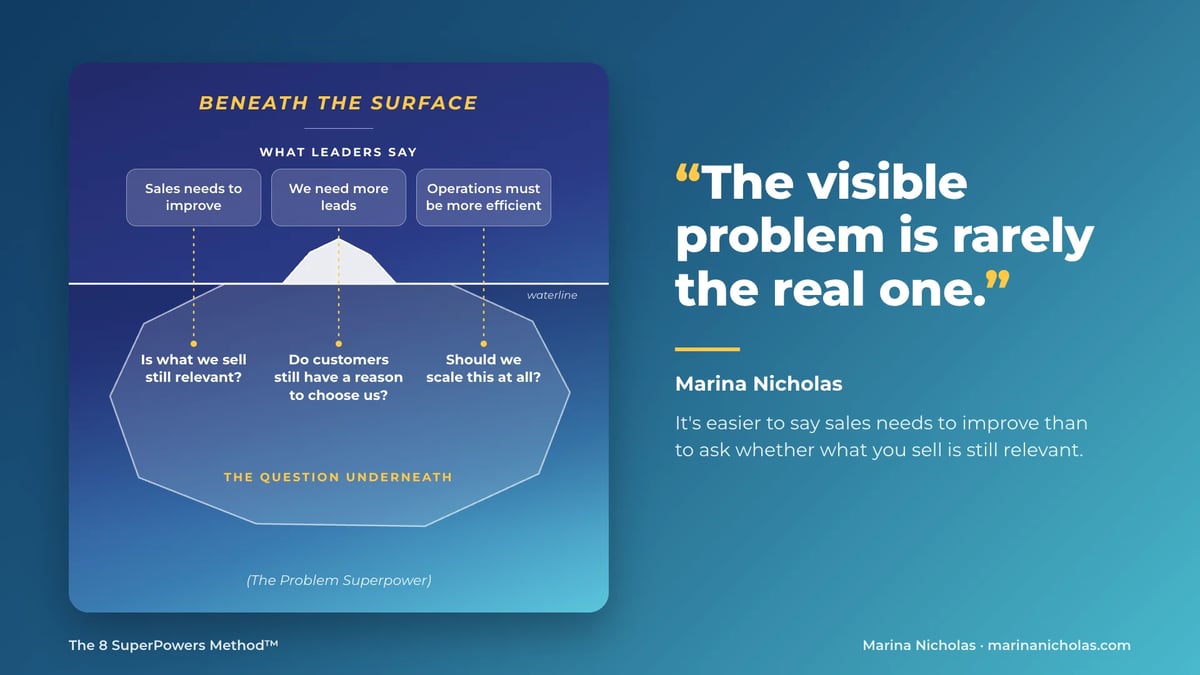
Where do the 8 Superpowers fit?
This is why I don't diagnose a business through one lens.
A recurring problem usually shows up across several of the 8 Superpowers at once, and each one gives you a different angle on what sits beneath the surface.
Problem — is this the problem that actually matters to the customer, or the one that is easiest to name internally?
Perseverance — are we solving this because the evidence supports it, or because we have already invested heavily in this version of the answer?
Positioning — is the work we are trying to fix valued by the market, or are we making something excellent that fewer people want?
Proximity — are we close enough to the customer to know which problem they would actually pay to have solved?
People — does the team have the capability to solve this, or are we solving it by working harder?
Partnerships — could someone else solve this faster, better or more cheaply than we can?
Process — is this a one-off problem, or the visible symptom of a system that will keep producing it?
Planet — are we solving for the next quarter while creating a problem for the next three years?
That's why I see problem solving as an interconnected system.
You can solve the visible problem brilliantly and still leave the constraint exactly where it was.
The question I'd put to your leadership team
At your next leadership meeting, take the problem you are currently spending the most energy on.
Then ask:
Is this the constraint, or is this the symptom of the constraint?
If the room goes quiet, you have found something more useful than a plan.
Because the objective isn't to get better at solving problems. It's to get better at choosing which problems deserve to be solved.
The Boardroom Question
If we took our five biggest current initiatives and removed them all tomorrow, which problems would still be there?
Those are the ones worth your attention.
Everything that disappears with the initiative was never the constraint.
Which of the 8 Superpowers is hiding the real problem in your business? Take the free Growth Gap Report. It takes around five minutes and helps identify where growth may be getting stuck across the interconnected parts of your business.
And if a CEO or MD came to mind while reading this, send it to them.
— Marina Nicholas
The 8 Superpowers Growth Hub
Where To Go From Here
If this sounds like your business, there are three ways to work on it with Marina:
- Free Growth Gap Report — 5 minutes to see where growth is constrained
- The Growth Intensive — 4 weeks with Marina on one or two contained problems
- The 8 Superpowers Accelerator — 12 weeks with Marina as your Strategic Growth COO
New to the method? Read about The 8 Superpowers Method™.