What Business Growth Phase Am I Really In?
Did You Know a 35-Year-Old Business Can Still Be a Toddler?
Key Takeaways
- Chronological age is not growth age. A 35-year-old business can still behave like a Toddler. A 3-year-old company can already be in a Mid-Life crisis. The two ages are not the same.
- Ten recognisable phases of the business lifecycle. From Birth to Death, each is a pattern of behaviour, not a year on a timeline.
- The same solution helps one stage and damages another. Diagnose before you prescribe. Ask "What stage are we really in?" before deciding what to change.
What growth phase is my business actually in?
Here's the misdiagnosis I've seen more often than any other, in business after business: leadership teams assume the age of the company tells them the stage of the company. It doesn't.
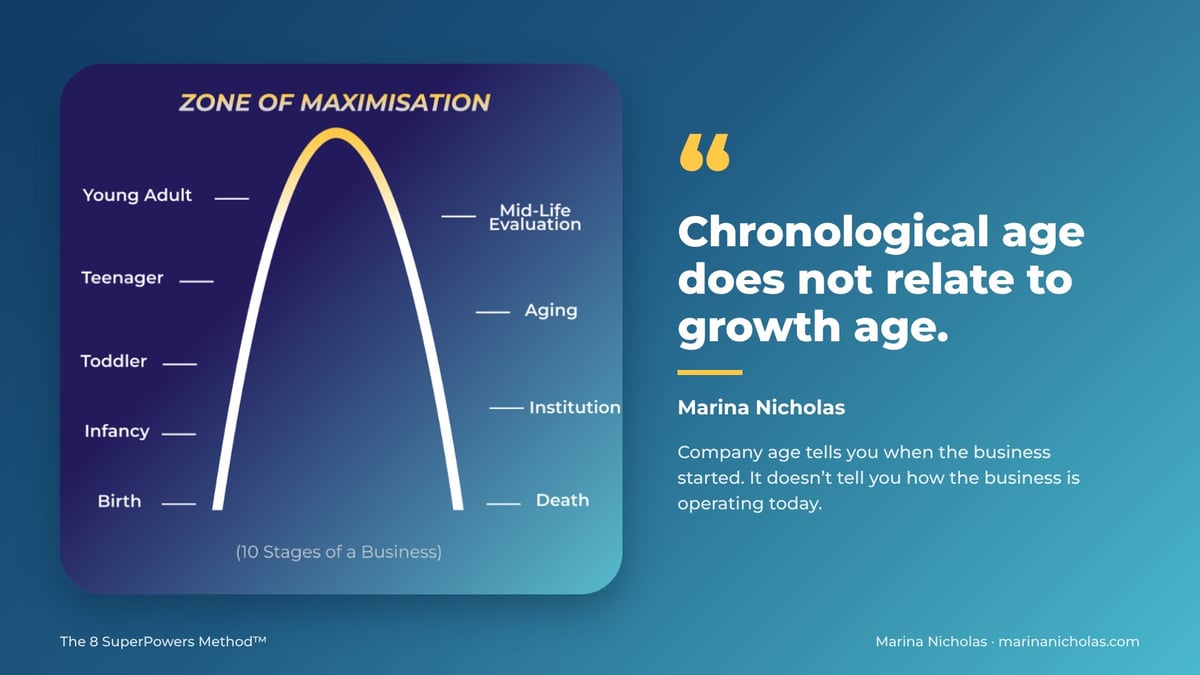
"Chronological age does not relate to growth age."
A business can be 35 years old and still behave like a Toddler. A 50-year-old company can operate like a Teenager. A 3-year-old company can already be going through a Mid-Life crisis. And a Startup company can reach its Zone of Maximisation extraordinarily quickly, like Zappos and Airbnb.
That sounds contradictory. But once you stop looking at the company's age and start looking at its behaviour, it makes complete sense.
So what is a business's real age?
Company age tells you when it started. Growth age tells you how it operates. And those are two completely different things.
Over the years, I've used recognisable phases in the business lifecycle:
Birth → Infancy → Toddler → Teenager → Young Adult → Zone of Maximisation → Mid-Life Evaluation → Aging → Institution → Death
These aren't age brackets. They're patterns of behaviour.
Take the Toddler
It might have been trading for 20 years, with revenue to match. What makes it a Toddler isn't its size. It's how it behaves:
- Every important decision returns to the owner.
- Constant firefighting.
- Inconsistent systems.
- Too many priorities.
- Growth dependent on a handful of people.
At the other end, a company in its Zone of Maximisation may be performing brilliantly. Which means its biggest danger can become success itself. Complacency. Protecting what worked. Assuming tomorrow will behave like yesterday.
That's why the same management intervention cannot work at every stage.
This is where leaders get caught
Most leadership teams diagnose the visible symptom.
- Growth slows? Increase marketing.
- Decisions keep returning to the CEO? Hire more managers.
- Execution is inconsistent? Add another system.
- People are busy? Recruit more people.
But the same solution can help one stage and damage another. A Toddler may desperately need more structure. A company in Institution may already be suffocating under too much of it. A Teenager may need stronger accountability. A company in the Zone of Maximisation may need the opposite of greater control: disruption, experimentation and enough constructive tension to stop success turning into stagnation.
So before prescribing a solution, I ask a different question: what behaviour is this company displaying?
A quick test: is your business behaving like a Toddler?
Forget your turnover and company age for a moment. Your business may be behaving like a Toddler if three or more of these are true:
- If you disappeared for three months, important decisions would stop.
- You have twelve priorities, not three.
- Priorities change from week to week.
- Good people are compensating for weak systems.
- Growth depends on a handful of people.
Those answers tell me far more about the maturity of a business than whether it was founded in 1991 or 2021.
Why the stage changes how you lead
Leadership has to evolve with the business. The skills that create one stage can become the constraint at the next.
The founder who personally drives every sale may be exactly what the business needs in Infancy. In Toddler, that same behaviour starts creating dependency. The systems that create consistency can eventually create bureaucracy. The caution that protects a mature business can eventually prevent innovation.
So three things matter.
1. Diagnose before prescribing. Don't start with "What should we change?" Start with "What stage are we actually in, and what behaviour tells us that?"
2. Lead for the stage you're in. A CEO leading a Toddler often has to stop being the answer to every question. A leader in the Zone of Maximisation may have to do almost the reverse, and challenge a successful organisation before comfort sets in. A leader in the Mid-Life Crisis needs the courage to question assumptions that may have created the company's success in the first place.
3. Build for the next stage before you reach it. The strongest leadership teams ask what will stop working next. Which process fails at twice the volume? Which decisions still depend on one person? Which capability will the next stage require?
Growth becomes less painful when you prepare for the next stage before it becomes a crisis.
What does this look like in a real business?
I worked with Equestrian Surfaces, a 35-year-old family business with turnover of around £6.75m.
Chronologically, it was a mature company. But age wasn't the useful diagnosis. Growth still depended heavily on referrals, telesales and the MD's personal relationships. The next generation was ready to take on greater responsibility. The business itself wasn't yet ready to be handed over. That distinction mattered.
Over time, we worked across leadership, positioning, process and succession. The company developed a growth plan targeting £9.6m turnover, built a 90-day execution rhythm, mapped the business-development capability it needed and, crucially, developed a management team capable of carrying more responsibility.
They achieved the growth target. But the most important change wasn't simply revenue. The organisation began moving into its next stage of maturity. From Toddler to Teenager into the Zone of Maximisation. The age of the business wasn't the diagnosis. Its stage was.
Where do the 8 Superpowers fit?
The growth phase tells me what transition a business is facing. The 8 Superpowers Method™ shows where the constraint sits.
At Equestrian Surfaces, three of them carried the transition:
- People: building capability beyond the MD, so the next generation could lead.
- Process: making performance repeatable without heroic effort.
- Positioning: sharpening the market focus, so growth no longer relied on referrals and relationships.
Two companies can be the same age, the same size and in the same sector, and need completely different growth strategies. Because they're in completely different phases.
The question I'd put to your leadership team next time you meet
At your next leadership meeting, don't ask: "How old is this company?"
Ask: "If we ignored our age and our revenue, what stage would our behaviour tell us we're really in?"
The answer may explain why the growth strategy you've been trying isn't getting you into the Zone of Maximisation.
Which of the 8 Superpowers is holding further growth back? Take the free Growth Gap Report. It takes around five minutes and shows where growth is constrained in your business, across the 8 Superpowers of sustainable growth.
And if a CEO or MD came to mind while reading this, send it to them.
Marina Nicholas
The 8 Superpowers Growth Hub
Where To Go From Here
If this sounds like your business, there are three ways to work on it with Marina:
- Free Growth Gap Report — 5 minutes to see where growth is constrained
- The Growth Intensive — 4 weeks with Marina on one or two contained problems
- The 8 Superpowers Accelerator — 12 weeks with Marina as your Strategic Growth COO
New to the method? Read about The 8 Superpowers Method™.